Introduction: Light Is Your Most Important Input
In vertical farming, light is your most important input. But measuring and optimizing light requires understanding two key metrics: PPFD and DLI. This complete PPFD and DLI guide explains what they mean, how to measure them, and optimal values for 15+ crops.
In vertical farming, light is not just an expense — it’s your primary production tool. Get it wrong, and your plants struggle. Get it right, and you maximize yield, reduce electricity costs, and grow consistently high-quality crops.
But here’s the problem: most growers don’t truly understand the two most important light metrics — PPFD and DLI.
This guide will change that. You’ll learn:
- What PPFD and DLI actually mean
- How to measure them correctly
- Optimal values for 15+ crops
- How to calculate DLI from PPFD
- Common mistakes and how to avoid them
Part 1: What Is PPFD?
Definition
PPFD stands for Photosynthetic Photon Flux Density.
It measures the number of photosynthetically active photons (400-700nm) that hit one square meter of plant canopy every second.
Unit: µmol/m²/s (micromoles per square meter per second)
Why PPFD Matters
Think of PPFD as the intensity of light reaching your plants. Too low, and photosynthesis slows down. Too high, and you waste electricity — or worse, damage your plants.
| PPFD Level | Effect on Plants |
|---|---|
| Below 100 | Very slow growth, stretching |
| 100-200 | Adequate for low-light crops (microgreens) |
| 200-400 | Optimal for leafy greens and herbs |
| 400-600 | High light for fruiting crops |
| Above 600 | Only for very high-light crops; risk of burn |
How to Measure PPFD
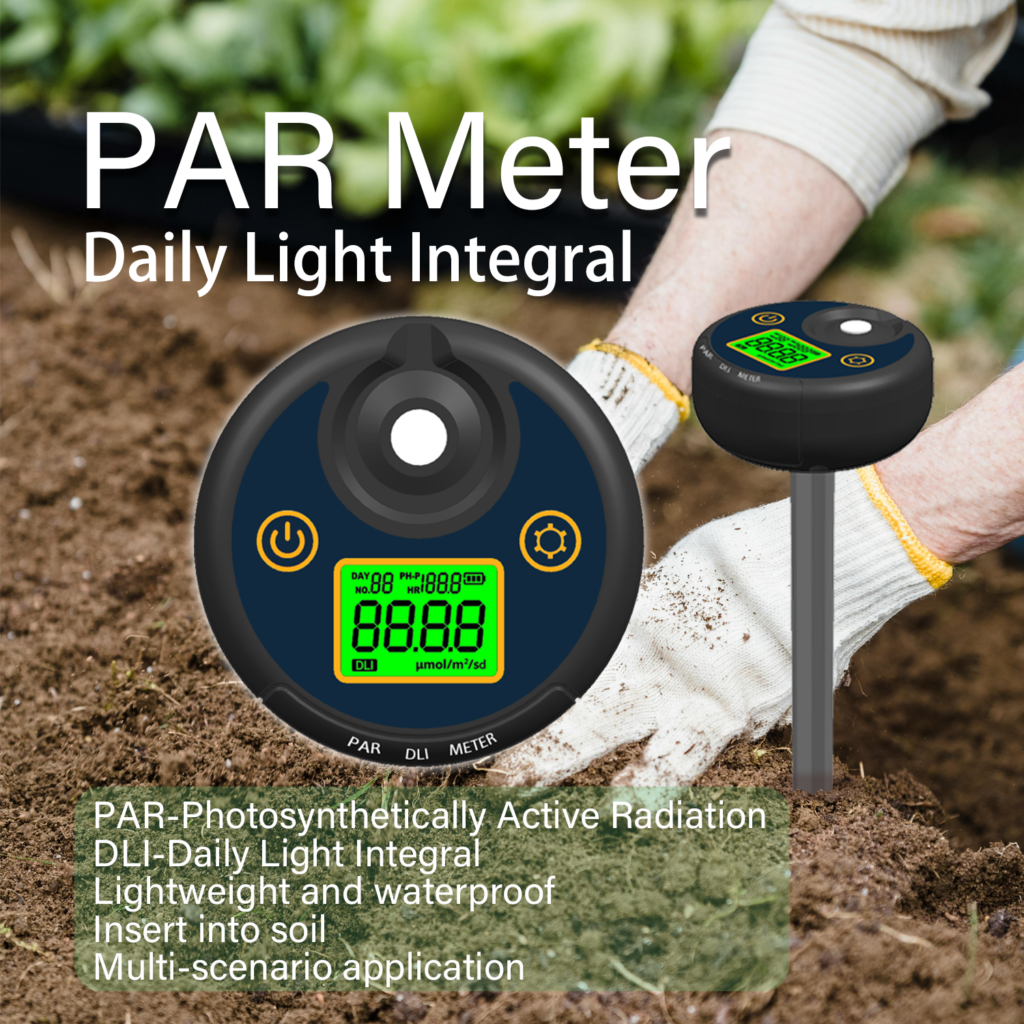
You need a quantum PAR meter. These devices cost $150-500 and are essential for any serious grower.
Step-by-step measurement:
- Place the sensor at canopy level (top of leaves)
- Measure at multiple points across your grow area (9-point grid)
- Record each reading
- Calculate the average PPFD
- Identify hot spots and dark spots
9-point grid example for a 1.2m × 0.6m tray:
| Position | Reading (µmol/m²/s) |
|---|---|
| Top-left | 320 |
| Top-center | 350 |
| Top-right | 310 |
| Middle-left | 340 |
| Center | 360 |
| Middle-right | 330 |
| Bottom-left | 300 |
| Bottom-center | 320 |
| Bottom-right | 290 |
| Average | 324 |
Uniformity Matters
Good light fixtures have less than 20% variation across the canopy. If your corners are 200 and center is 400, plants will grow unevenly.
Target uniformity: PPFD variation ≤ ±20% from average
Part 2: What Is DLI?
Definition
DLI stands for Daily Light Integral.
It measures the total amount of photosynthetically active photons delivered to one square meter of plant canopy over 24 hours.
Unit: mol/m²/day (moles per square meter per day)
Why DLI Matters
While PPFD tells you light intensity at a single moment, DLI tells you the total light energy your plants receive all day.
Plants don’t care about intensity alone — they care about total daily dose. A plant receiving 200 µmol/m²/s for 18 hours gets the same DLI as a plant receiving 300 µmol/m²/s for 12 hours.
The DLI Formula
DLI = PPFD × Light hours per day × 0.0036
Why 0.0036? Because 1 µmol/m²/s × 3600 seconds/hour × (1 mol/1,000,000 µmol) × 1 hour = 0.0036
Examples:
| PPFD | Hours | Calculation | DLI (mol/m²/day) |
|---|---|---|---|
| 200 | 16 | 200 × 16 × 0.0036 | 11.5 |
| 300 | 16 | 300 × 16 × 0.0036 | 17.3 |
| 400 | 16 | 400 × 16 × 0.0036 | 23.0 |
| 200 | 18 | 200 × 18 × 0.0036 | 13.0 |
| 300 | 12 | 300 × 12 × 0.0036 | 13.0 |
Why DLI Is More Useful Than PPFD Alone
| Scenario | PPFD | Hours | DLI | Which is better? |
|---|---|---|---|---|
| Setup A | 400 | 12 | 17.3 | Same DLI |
| Setup B | 300 | 16 | 17.3 | Same DLI |
Both deliver the same total light energy. Setup B uses less intense light but longer duration — often more energy-efficient and gentler on plants.
Part 3: Optimal PPFD and DLI by Crop
Low-Light Crops (100-200 PPFD, 6-12 DLI)
| Crop | PPFD (µmol/m²/s) | DLI (mol/m²/day) | Photoperiod |
|---|---|---|---|
| Mushrooms | 50-100 | 3-6 | 8-12 hours |
| Microgreens | 100-150 | 6-10 | 16 hours |
| Herbs (shade-tolerant) | 100-200 | 8-12 | 14-16 hours |
Medium-Light Crops (200-400 PPFD, 12-18 DLI)
| Crop | PPFD (µmol/m²/s) | DLI (mol/m²/day) | Photoperiod |
|---|---|---|---|
| Lettuce | 200-300 | 12-15 | 16-18 hours |
| Kale | 200-350 | 12-17 | 16-18 hours |
| Spinach | 200-350 | 12-17 | 16 hours |
| Arugula | 200-300 | 12-15 | 16-18 hours |
| Basil | 200-300 | 12-16 | 16 hours |
| Cilantro | 150-250 | 10-14 | 16 hours |
| Mint | 150-250 | 10-14 | 16 hours |
High-Light Crops (350-600 PPFD, 18-30 DLI)
| Crop | PPFD (µmol/m²/s) | DLI (mol/m²/day) | Photoperiod |
|---|---|---|---|
| Tomatoes | 400-600 | 20-30 | 12-14 hours |
| Peppers | 350-550 | 18-25 | 12-14 hours |
| Strawberries | 300-450 | 15-22 | 12-14 hours |
| Cucumbers | 400-600 | 20-30 | 14-16 hours |
| Cannabis | 500-900 | 30-45 | 12-18 hours |
Very High-Light Crops (600+ PPFD, 30+ DLI)
| Crop | PPFD (µmol/m²/s) | DLI (mol/m²/day) | Photoperiod |
|---|---|---|---|
| Cannabis (flowering) | 600-900 | 30-45 | 12 hours |
| High-light ornamentals | 500-800 | 25-40 | 14-16 hours |
Part 4: How to Calculate DLI for Your Setup
Step 1: Measure Average PPFD
Use your PAR meter at canopy level. Take readings from 9 points and calculate the average.
Example average PPFD: 320 µmol/m²/s
Step 2: Determine Your Photoperiod
How many hours per day are your lights on?
Example photoperiod: 16 hours
Step 3: Apply the Formula
DLI = PPFD × Hours × 0.0036
Example calculation: 320 × 16 × 0.0036 = 18.4 mol/m²/day
Step 4: Compare to Crop Requirements
For lettuce (target DLI 12-15), 18.4 is too high. You need to:
- Reduce PPFD (dim lights or raise them)
- Reduce photoperiod (run lights for fewer hours)
- Or both
Online DLI Calculator
You can also use online DLI calculators:
- Search “DLI calculator hydroponics”
- Input PPFD and hours
- Get instant DLI result
Part 5: PPFD and DLI by Growth Stage
Different growth stages have different light requirements.
Germination (Days 1-5)
| Parameter | Value |
|---|---|
| PPFD | 5-20 µmol/m²/s |
| DLI | 0.3-1.5 mol/m²/day |
| Photoperiod | 16 hours (or darkness for some seeds) |
Note: Most seeds germinate in darkness. Low light is optional.
Seedling Stage (Days 6-12)
| Parameter | Value |
|---|---|
| PPFD | 100-200 µmol/m²/s |
| DLI | 6-12 mol/m²/day |
| Photoperiod | 16-18 hours |
Goal: Prevent stretching without burning young leaves.
Vegetative Stage (Days 13-25)
| Parameter | Value |
|---|---|
| PPFD | 200-400 µmol/m²/s |
| DLI | 12-18 mol/m²/day |
| Photoperiod | 16-18 hours |
Goal: Maximize leaf growth and biomass.
Flowering/Fruiting Stage (After Day 25)
| Parameter | Value |
|---|---|
| PPFD | 400-600 µmol/m²/s |
| DLI | 18-30 mol/m²/day |
| Photoperiod | 12-14 hours (fruiting crops) or 16+ (day-neutral) |
Goal: Maximize flower and fruit production.
Part 6: PPFD Distribution — The 9-Point Test
Why Uniformity Matters
Plants at the edges of your grow area often receive less light than plants in the center. This leads to:
- Uneven growth
- Lower total yield
- Wasted space
How to Perform a 9-Point Test
- Divide your grow tray into a 3×3 grid
- Measure PPFD at each grid point
- Record readings
- Calculate average
- Check variation
Example Results
| Position | Reading (µmol/m²/s) |
|---|---|
| 1 (TL) | 280 |
| 2 (TC) | 310 |
| 3 (TR) | 290 |
| 4 (ML) | 300 |
| 5 (C) | 340 |
| 6 (MR) | 310 |
| 7 (BL) | 270 |
| 8 (BC) | 290 |
| 9 (BR) | 260 |
Average: 294 µmol/m²/s
Range: 260-340 (27% variation)
Assessment: Poor uniformity — needs adjustment
How to Improve Uniformity
| Problem | Solution |
|---|---|
| Center too bright | Raise lights |
| Corners too dark | Add more fixtures or move lights closer |
| One side darker | Check light angle, adjust fixture position |
| Hot spots | Use diffusers or raise lights |
Target: ≤20% variation from average
Part 7: Light Distance and Coverage
Inverse Square Law (Simplified)
Light intensity decreases rapidly with distance. Doubling the distance = one-quarter the intensity.
Recommended Light Heights
| Growth Stage | Light Height Above Canopy |
|---|---|
| Germination | N/A (minimal light) |
| Seedling | 60-80 cm |
| Vegetative | 40-60 cm |
| Flowering | 30-50 cm |
Finding Your Optimal Height
- Start at manufacturer’s recommended height
- Measure PPFD at canopy level
- Raise or lower to achieve target PPFD
- Re-test uniformity
- Record optimal height for each stage
Part 8: Photoperiod Strategies
Long Photoperiod (16-18 hours)
Best for: Leafy greens, herbs, vegetative stage
Pros:
- Lower PPFD needed for same DLI
- More energy-efficient
- Gentler on plants
Cons:
- Requires longer daily runtime
- May not work for flowering crops
Short Photoperiod (12-14 hours)
Best for: Fruiting crops, flowering stage
Pros:
- Triggers flowering in short-day plants
- Shorter daily runtime
Cons:
- Requires higher PPFD for same DLI
- Higher light intensity may cause stress
Continuous Light (24 hours)
Not recommended for most crops. Plants need dark periods for respiration and recovery.
Exceptions: Some microgreens and certain leafy greens can tolerate 24-hour light, but research shows diminishing returns.
Part 9: Common PPFD and DLI Mistakes
Mistake 1: Measuring Only One Point
Problem: Center of tray might be 400 PPFD while corners are 200. Your plants grow unevenly.
Solution: Always measure 9-point grid. Aim for ≤20% variation.
Mistake 2: Ignoring DLI
Problem: You measure 300 PPFD and assume it’s good, but lights run only 10 hours → DLI is only 10.8 (too low for most crops).
Solution: Calculate DLI. Adjust hours or intensity to meet crop requirements.
Mistake 3: Using Phone Apps Instead of PAR Meters
Problem: Phone light sensors are not calibrated for plant lighting. Readings can be 50% off.
Solution: Buy or borrow a real quantum PAR meter.
Mistake 4: Forgetting Light Degradation
Problem: LEDs lose intensity over time (5-15% in first 2 years). Your PPFD today is lower than when lights were new.
Solution: Re-measure PPFD every 6 months. Adjust height or dimming accordingly.
Mistake 5: Same Light for All Growth Stages
Problem: Seedlings receiving 400 PPFD (too high) and flowering crops receiving 200 PPFD (too low).
Solution: Use separate zones or tunable lights for each growth stage.
Part 10: PPFD and DLI Quick Reference Card
By Crop Type
| Crop Type | PPFD (µmol/m²/s) | DLI (mol/m²/day) | Photoperiod |
|---|---|---|---|
| Microgreens | 100-150 | 6-10 | 16 hrs |
| Leafy greens | 200-350 | 12-17 | 16-18 hrs |
| Herbs | 150-300 | 10-16 | 16 hrs |
| Fruiting | 350-600 | 18-30 | 12-14 hrs |
By Growth Stage
| Stage | PPFD (µmol/m²/s) | DLI (mol/m²/day) | Photoperiod |
|---|---|---|---|
| Germination | 5-20 | 0.3-1.5 | N/A |
| Seedling | 100-200 | 6-12 | 16-18 hrs |
| Vegetative | 200-400 | 12-18 | 16-18 hrs |
| Flowering | 400-600 | 18-30 | 12-14 hrs |
DLI Formula Card
text复制下载
DLI = PPFD × Hours × 0.0036

Examples:
200 PPFD × 16 hrs = 11.5 DLI
300 PPFD × 16 hrs = 17.3 DLI
400 PPFD × 16 hrs = 23.0 DLI
Part 11: Troubleshooting Light Problems
| Problem | Possible Cause | Solution |
|---|---|---|
| Leggy, stretched seedlings | PPFD too low | Increase PPFD to 150-200 |
| Bleached white leaves | PPFD too high | Raise lights or dim |
| Slow growth | DLI too low | Increase hours or intensity |
| Leaf burn at edges | Uneven PPFD | Improve uniformity |
| Lower leaves dying | Poor light penetration | Add side lighting or reduce canopy density |
| High electricity bill | Inefficient lights or too high PPFD | Measure PPFD, reduce if above crop needs |
| Plants flowering too early | Photoperiod too short (for long-day plants) | Increase light hours |
Part 12: Equipment Recommendations
PAR Meters by Budget
| Budget | Product | Approximate Price | Accuracy |
|---|---|---|---|
| Entry | Uni-T BT UT383BT | $40-60 | Acceptable for hobby |
| Mid-range | SpotOn PAR Meter | $150-200 | Good for commercial |
| Professional | Apogee MQ-500 | $500-600 | Highest accuracy |
| Premium | LI-COR LI-250A | $1,000+ | Research grade |
Light Timers
| Type | Price | Best For |
|---|---|---|
| Mechanical outlet timer | $5-15 | Simple on/off schedules |
| Digital outlet timer | $10-25 | Multiple programs, battery backup |
| Smart plug (Wi-Fi) | $15-30 | App control, remote monitoring |
| Lighting controller | $100-500 | Commercial systems, dimming, sunrise/sunset |
Part 13: Daily Light Log Template
Copy this template to track your light settings.
| Date | Crop | Stage | PPFD Avg | Hours | DLI | Notes |
|---|---|---|---|---|---|---|
Summary: Key Takeaways
- PPFD measures light intensity at a single moment (µmol/m²/s)
- DLI measures total daily light (mol/m²/day) = PPFD × hours × 0.0036
- Measure 9 points — uniformity matters as much as average PPFD
- Match DLI to your crop — leafy greens need 12-17, fruiting crops need 18-30
- Adjust by growth stage — seedlings need less light than flowering plants
- Buy a PAR meter — phone apps are not accurate enough
- Re-measure every 6 months — LEDs lose intensity over time
- Don’t ignore DLI — it’s more important than PPFD alone
Next Steps
Ready to optimize your lighting?
- Read our LED Spectrum Deep Dive for spectrum strategies
- Read our Nutrient Management Guide for complementary parameters
- Contact us for customized light planning for your farm