Introduction: Light Is More Than Just Brightness
In vertical farming, light is not just about illumination — it’s the primary energy source driving photosynthesis, growth, and ultimately your harvest.
But here’s what many growers miss: different wavelengths of light trigger completely different responses in plants.
Blue light tells plants to stay compact. Red light drives photosynthesis and flowering. Far-red light signals shade avoidance. Understanding these differences allows you to optimize your spectrum for each growth stage and crop type.
This guide covers:
- The science behind each wavelength
- How different spectra affect plant morphology
- Spectrum strategies by crop and growth stage
- How to choose and configure LED lights for your farm
Part 1: The Light Spectrum — A Quick Refresher
Visible light for plants ranges from approximately 400 to 700 nanometers (nm). This range is called PAR — Photosynthetically Active Radiation.
| Wavelength Range | Color | Key Effects on Plants |
|---|---|---|
| 400-500 nm | Blue | Leaf growth, compact structure, stomatal control |
| 500-600 nm | Green | Canopy penetration, lower leaf photosynthesis |
| 600-700 nm | Red | Photosynthesis, stem elongation, flowering |
| 700-750 nm | Far-red | Shade avoidance, flowering timing, leaf expansion |
Key insight: Plants don’t use all wavelengths equally. They have evolved to respond differently to each part of the spectrum.
Part 2: Blue Light (400-500 nm) — The Structural Builder
What Blue Light Does
Blue light is essential for vegetative growth. It:
- Promotes compact, sturdy plant structure (shorter internodes)
- Enhances leaf thickness and chlorophyll content
- Controls stomatal opening (affects water and CO₂ exchange)
- Improves nutrient density (higher antioxidants, flavonoids)
Why Blue Light Matters
Plants grown under insufficient blue light become leggy — tall, weak stems with widely spaced leaves. This is the plant’s natural response to shade: it stretches toward light.
In a vertical farm, leggy plants are inefficient. They take up more vertical space, shade lower leaves, and produce less harvestable biomass per square meter.
Optimal Blue Light Percentage by Growth Stage
| Growth Stage | Blue Percentage | Why |
|---|---|---|
| Germination | 5-10% | Minimal light needed |
| Seedling | 20-30% | Prevent stretching, build strong stems |
| Vegetative | 15-25% | Maintain compact structure |
| Flowering/Fruiting | 5-15% | Reduce blue to favor flowering |
Crops That Benefit from Higher Blue
- Leafy greens (lettuce, kale, spinach) — prefer 15-25% blue
- Herbs (basil, cilantro) — 15-20% blue
- Microgreens — 20-30% blue for compact growth
Part 3: Red Light (600-700 nm) — The Photosynthesis Driver
What Red Light Does
Red light is the most photosynthetically efficient wavelength. It:
- Drives photosynthesis more effectively than any other color
- Promotes stem elongation (can be good or bad)
- Triggers flowering in many species
- Increases biomass accumulation
Why Red Light Matters
Plants absorb red light very efficiently. For the same amount of electricity, red light produces more photosynthetic energy than blue light.
However, too much red without enough blue leads to:
- Excessive stem elongation
- Thin, weak plants
- Lower leaf quality
Optimal Red Light Percentage by Growth Stage
| Growth Stage | Red Percentage | Why |
|---|---|---|
| Germination | 0-5% | Not needed |
| Seedling | 50-60% | Balanced with blue |
| Vegetative | 60-70% | Drive biomass production |
| Flowering/Fruiting | 70-80% | Maximize yield |
The Red-to-Blue Ratio
Most commercial LED fixtures use a red-to-blue ratio between 3:1 and 5:1 (red:blue).
| Ratio | Best For |
|---|---|
| 3:1 (75% red, 25% blue) | Leafy greens, balanced growth |
| 4:1 (80% red, 20% blue) | Flowering crops, higher yield |
| 5:1 (83% red, 17% blue) | Fruiting crops, maximum biomass |
Part 4: Far-Red Light (700-750 nm) — The Shade Signal
What Far-Red Light Does
Far-red light is not photosynthetically efficient on its own, but it has powerful morphological effects:
- Triggers shade avoidance response (stem elongation, larger leaves)
- Accelerates flowering in long-day plants
- Improves light penetration into dense canopies
- Increases leaf expansion when combined with red
The Emerson Enhancement Effect
When red (660 nm) and far-red (730 nm) are delivered simultaneously, photosynthesis increases beyond what either wavelength achieves alone. This is called the Emerson Enhancement Effect.
Practical implication: Adding 5-10% far-red to your red-heavy spectrum can increase yield without increasing electricity consumption.
Why Far-Red Matters
Many commercial LED fixtures now include far-red LEDs. Here’s when to use them:
| Crop Type | Far-Red Benefit |
|---|---|
| Lettuce | Increases leaf size, faster growth |
| Basil | Promotes bushier growth |
| Tomatoes (fruiting) | Accelerates flowering, higher yield |
| Leafy greens | Improves lower canopy light penetration |
Far-Red Risks
Too much far-red causes:
- Excessive stem elongation (leggy plants)
- Reduced leaf thickness
- Lower nutrient density
Recommendation: Start with 5-10% far-red and observe plant response.
Part 5: Green Light (500-600 nm) — The Canopy Penetrator
What Green Light Does
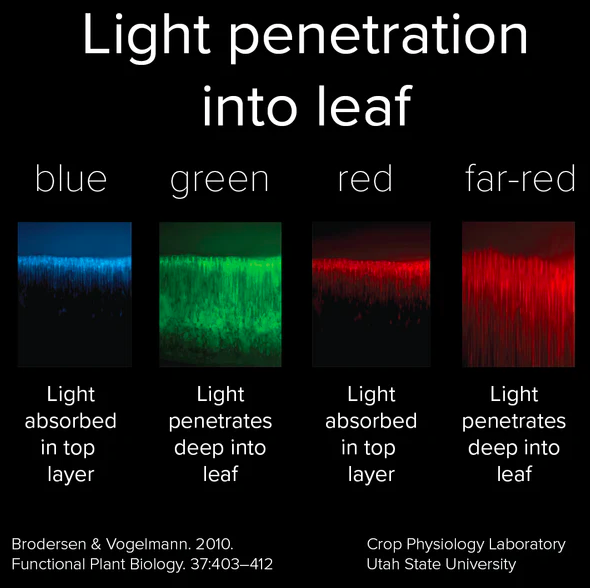
Green light was long thought to be useless for plants because leaves reflect it (which is why plants look green). But research shows green light:
- Penetrates deeper into plant canopies than red or blue
- Drives photosynthesis in lower leaves that red/blue can’t reach
- Improves overall photosynthetic efficiency in dense crops
- Helps growers inspect plants (white light makes pest detection easier)
Why Green Light Matters
In a dense canopy (basil, tomatoes, trellised crops), the top leaves absorb most red and blue light. Lower leaves receive very little photosynthetically useful light.
Green light passes through top leaves and reaches lower leaves, contributing to overall plant productivity.
Optimal Green Light Percentage
| Crop Density | Green Percentage |
|---|---|
| Sparse (lettuce, microgreens) | 0-5% |
| Medium (herbs, kale) | 5-10% |
| Dense (basil, tomatoes) | 10-15% |
Part 6: UV Light (300-400 nm) — The Stress Signal
What UV Light Does
UV light is not required for plant survival, but controlled UV exposure:
- Triggers defense compounds (flavonoids, terpenes, antioxidants)
- Improves flavor, color, and nutritional value
- Increases pest resistance
- Can reduce pathogen pressure
Why UV Matters for Commercial Growers
For growers focused on premium markets (chefs, health-conscious consumers), UV-enhanced crops command higher prices.
| Crop | UV Benefit |
|---|---|
| Basil | Increases essential oil content (stronger flavor) |
| Lettuce | Enhances red pigmentation (anthocyanins) |
| Microgreens | Boosts antioxidant levels |
| Herbs | Improves aroma and taste |
UV Risks
Too much UV causes:
- Leaf damage (burning, bleaching)
- Reduced growth
- Plant stress
Recommendation: Add UV only during the last 3-5 days before harvest (finishing treatment). Use low intensity (5-10 W/m²) for 2-4 hours per day.
Part 7: Spectrum by Growth Stage — A Practical Guide
Germination Stage (Days 1-5)
| Parameter | Recommendation |
|---|---|
| Blue | 5-10% |
| Red | 0-5% |
| Far-red | 0% |
| PPFD | 5-10 µmol/m²/s |
| Photoperiod | 16-18 hours |
Goal: Minimal light, focus on temperature and humidity.
Seedling Stage (Days 6-12)
| Parameter | Recommendation |
|---|---|
| Blue | 20-30% |
| Red | 50-60% |
| Far-red | 0-5% |
| PPFD | 100-200 µmol/m²/s |
| Photoperiod | 16-18 hours |
Goal: Prevent stretching, build strong root system and stem structure.
Vegetative Stage (Days 13-25)
| Parameter | Recommendation |
|---|---|
| Blue | 15-25% |
| Red | 60-70% |
| Far-red | 5-10% |
| PPFD | 200-400 µmol/m²/s |
| Photoperiod | 16-18 hours |
Goal: Maximize leaf growth and biomass accumulation.
Flowering/Fruiting Stage (After Day 25)
| Parameter | Recommendation |
|---|---|
| Blue | 5-15% |
| Red | 70-80% |
| Far-red | 5-10% |
| PPFD | 400-600 µmol/m²/s |
| Photoperiod | 12-14 hours (fruiting crops) or 16+ hours (day-neutral) |
Goal: Maximize flower and fruit production.
Part 8: Spectrum by Crop Type
Leafy Greens (Lettuce, Kale, Spinach, Arugula)
| Parameter | Recommendation |
|---|---|
| Red:Blue ratio | 3:1 to 4:1 |
| Far-red | 5-8% |
| PPFD | 200-350 µmol/m²/s |
| Photoperiod | 16-18 hours |
Goal: Fast growth, compact structure, high yield per square meter.
Herbs (Basil, Cilantro, Mint, Parsley)
| Parameter | Recommendation |
|---|---|
| Red:Blue ratio | 3:1 to 4:1 |
| Far-red | 5-10% |
| PPFD | 200-300 µmol/m²/s |
| Photoperiod | 16 hours |
Goal: Bushy growth, essential oil production, flavor development.
Fruiting Crops (Tomatoes, Peppers, Strawberries)
| Parameter | Recommendation |
|---|---|
| Red:Blue ratio | 4:1 to 5:1 |
| Far-red | 10-15% |
| PPFD | 400-600 µmol/m²/s |
| Photoperiod | 12-14 hours |
Goal: Flower initiation, fruit set, maximum yield.
Microgreens
| Parameter | Recommendation |
|---|---|
| Red:Blue ratio | 2:1 to 3:1 |
| Far-red | 0-5% |
| PPFD | 100-200 µmol/m²/s |
| Photoperiod | 16 hours |
Goal: Compact growth, vibrant colors, high nutrient density.
Part 9: How to Choose LED Grow Lights
Spectrum Checklist
When evaluating LED fixtures, ask these questions:
| Question | What to Look For |
|---|---|
| Is the spectrum full? | White light + specific red/blue peaks |
| Are red and blue wavelengths optimized? | Peaks around 450nm (blue) and 660nm (red) |
| Does it include far-red? | 730nm LED chip present |
| Is UV included? | Optional, good for premium crops |
| Can you adjust the spectrum? | Dimming controls for each channel |
Spectrum Types Compared
| Type | Pros | Cons | Best For |
|---|---|---|---|
| Full-spectrum white | Natural appearance, easy plant inspection | Less efficient than targeted red/blue | Leafy greens, herbs |
| Red-blue (blurple) | High efficiency, good for photosynthesis | Hard to inspect plants, eye strain | Commercial production |
| Tunable spectrum | Optimize for each stage | Expensive | Research, mixed crops |
| White + red boost | Balanced, efficient | Limited adjustability | Most vertical farms |
Efficiency Metrics
| Metric | Target | Why |
|---|---|---|
| Photon efficacy | 2.5-3.0 µmol/J | Lower electricity cost |
| PPFD uniformity | ±20% across canopy | Consistent growth |
| Lifetime (L90) | 50,000+ hours | Longer before replacement |
| Dimming capability | 0-10V or PWM | Adjust without moving lights |
Budget Reference
| Farm Size | Light Cost (USD) | Recommended Type |
|---|---|---|
| Small (1-2 racks) | $200-500 | Full-spectrum LED bars |
| Medium (4-6 racks) | $800-2,000 | Commercial bar lights with red-blue optimization |
| Large (10+ racks) | $2,000-8,000 | Tunable spectrum, high efficacy |
Part 10: Common Spectrum Mistakes
Mistake 1: Using Blurple Lights Only
Problem: Purple light makes it impossible to spot pests, diseases, or nutrient deficiencies. Long-term exposure causes eye strain.
Solution: Use full-spectrum white lights or add white LED bars for inspection periods.
Mistake 2: Too Much Blue Light
Problem: Excess blue reduces yield and increases electricity cost without benefit.
Solution: Reduce blue to 10-15% during flowering. Use higher blue only for seedlings and microgreens.
Mistake 3: Ignoring Far-Red
Problem: Missing the Emerson Enhancement Effect and potential yield increases.
Solution: Add 5-10% far-red, especially for leafy greens and fruiting crops.
Mistake 4: One Spectrum for All Stages
Problem: Seedlings stretch under low blue; flowering crops underperform under vegetative spectrum.
Solution: Use tunable lights or have separate zones for each growth stage.
Mistake 5: No UV for Premium Crops
Problem: Missing opportunity to increase nutritional value and flavor.
Solution: Add UV finishing treatment 3-5 days before harvest.
Part 11: Measuring and Adjusting Your Spectrum
Tools You Need
| Tool | Purpose | Budget |
|---|---|---|
| Full-spectrum PAR meter | Measure PPFD across wavelengths | $300-600 |
| Spectrometer | Analyze spectral distribution | $500-2,000 |
| Light timer | Control photoperiod | $10-30 |
Step-by-Step Spectrum Optimization
Step 1: Measure baseline
- Use PAR meter at canopy level (9-point grid)
- Record PPFD at each point
- Identify hot spots and dark spots
Step 2: Adjust height and intensity
- Raise or lower lights to achieve target PPFD
- Dim if needed to improve uniformity
Step 3: Adjust spectrum (if tunable)
- Set blue percentage for growth stage
- Set far-red percentage for crop type
- Record settings for each crop/stage
Step 4: Observe plant response
- Check for stretching (increase blue)
- Check for bleaching (reduce intensity)
- Check leaf color (adjust nutrient if needed)
Step 5: Document and repeat
- Log settings and plant response
- Refine over successive harvests
Part 12: Crop-Specific Spectrum Quick Reference
| Crop | Red:Blue | Far-Red | UV | PPFD | Photoperiod |
|---|---|---|---|---|---|
| Lettuce | 3:1 | 5-8% | Optional | 200-300 | 16-18 hrs |
| Kale | 3:1 | 5-8% | Optional | 200-350 | 16-18 hrs |
| Basil | 3.5:1 | 5-10% | Yes (finishing) | 200-300 | 16 hrs |
| Cilantro | 3:1 | 5-8% | No | 150-250 | 16 hrs |
| Mint | 3:1 | 5-8% | No | 150-250 | 16 hrs |
| Tomatoes | 4:1 | 10-15% | Optional | 400-600 | 12-14 hrs |
| Peppers | 4:1 | 10-15% | Optional | 350-500 | 12-14 hrs |
| Strawberries | 4:1 | 10-15% | No | 300-450 | 12-14 hrs |
| Microgreens | 2.5:1 | 0-5% | Yes | 100-200 | 16 hrs |
Summary: Key Takeaways
- Blue light builds structure — Use 20-30% for seedlings, reduce to 5-15% for flowering
- Red light drives photosynthesis — Most efficient wavelength, 60-80% of total spectrum
- Far-red increases yield — Add 5-10% for Emerson Enhancement Effect
- Green light penetrates canopies — Useful for dense crops like basil and tomatoes
- UV improves quality — Add as finishing treatment for premium markets
- Match spectrum to stage — Seedlings need more blue; flowering needs more red
- Measure, don’t guess — Use PAR meter to verify PPFD and uniformity
Next Steps
Ready to optimize your lighting strategy?
- Read our PPFD/DLI Complete Guide for advanced light metrics
- Read our Nutrient Management Guide for complementary growing parameters
- Contact us for customized spectrum recommendations for your crops